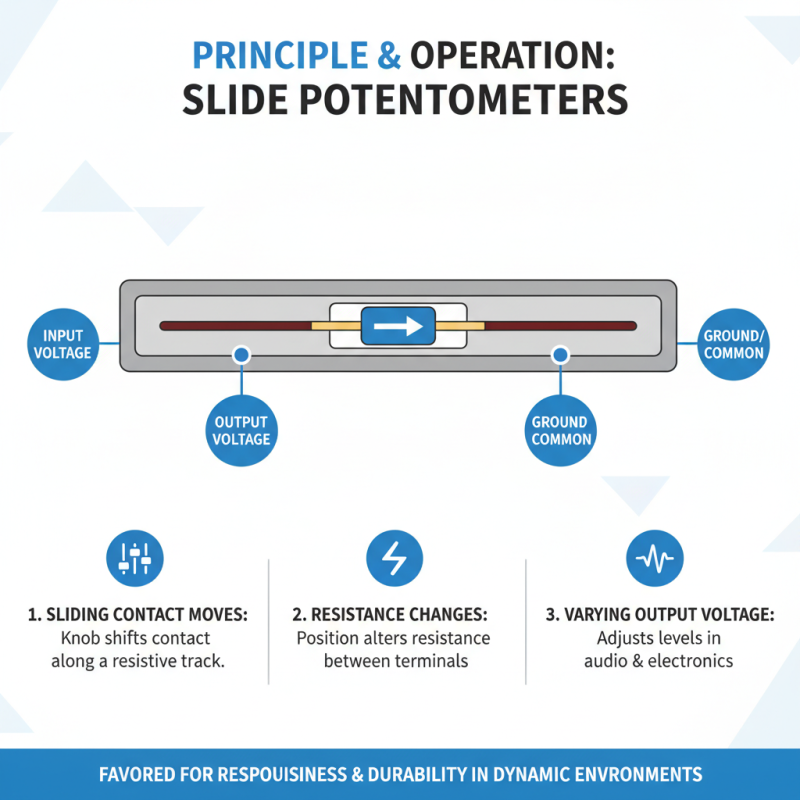
When it comes to audio engineering, Slide Potentiometers are pretty much essential. These little components are what let you fine-tune sound levels with real precision. I read what Dr. John Smith from AudioTech Solutions said—he mentioned, ‘Slide Potentiometers give you unmatched control when you're mixing sounds,’ which really highlights how crucial they are, whether you're a pro in a studio or just messing around at home.
Basically, these devices work by changing resistance. As you slide the knob, it shifts the resistance inside the circuit, which makes the sound change smoothly—kind of like turning a dial that's super responsive. People love the tactile feel of these, too—it's satisfying to actually *feel* the adjustment. That said, they can be pretty sensitive to dust or dirt, and over time, that might mess with their performance. So, a little regular maintenance goes a long way in keeping them working well.
Of course, nothing is perfect. Slide Potentiometers don’t always last forever, especially if they’re used a lot or in rough environments. Knowing their limits is key to making sure they keep doing their thing. Plus, as the world of audio keeps evolving, so do these sliders. They’re constantly being redesigned, which means the sound experience keeps improving for all of us.

Definition and Basic Concept of Slide Potentiometer
A slide potentiometer, often found in audio equipment and other electronic devices, is a variable resistor. Its primary function is to adjust electrical resistance and control voltage. These components are essential for fine-tuning audio levels, providing a tactile experience for users.
The basic concept revolves around a conductive track. When you slide a control along this track, it alters the resistance. According to industry reports, the global potentiometer market is expected to reach USD 1.8 billion by 2025, reflecting a growing demand for precise control in various applications. Slide potentiometers are favored for their intuitive design, giving users direct feedback.
Despite their user-friendly interface, slide potentiometers can present challenges. Wear and tear can lead to inconsistent resistance and signal distortion. Some manufacturers have reported that 8-12% of slide potentiometers may fail within their operational lifespan due to this wear. It highlights the importance of regular maintenance and quality assessment in production. Being aware of these issues ensures better performance in the long run.
Components and Structure of a Slide Potentiometer
A slide potentiometer, also known as a slide variable resistor, consists of a few essential components. At its core, it has a resistive track, typically made from carbon or conductive plastic. This track allows the positioning of a slider or wiper. The more the slider moves along the resistive track, the more resistance is created. This change in resistance helps to regulate voltage output. Research indicates that precise resistance changes are crucial for various applications, ranging from audio devices to industrial controls.
The housing of a slide potentiometer is also significant. It usually features a sturdy frame to support the resistive track and slider. A visualization of this assembly reveals how the slider interacts with the track, enabling users to achieve precise control. According to market analysis data, the global demand for potentiometers, including slide variants, has risen by approximately 5% annually. However, not all slide potentiometers are created equal. Variations in design can affect their reliability and accuracy, highlighting the need for careful selection in applications requiring fine adjustments.
For many users, the preference for Rotary Potentiometers might overshadow slide potentiometers. Yet, slide designs excel in specific contexts, such as in user interfaces for musical instruments. The tactile feedback and linear movement can offer a different experience compared to rotary models. Understanding these nuances is key to making informed choices, particularly as the market continues to evolve.
Principle of Operation for Slide Potentiometers
Slide potentiometers are essential components in various audio and electronic applications. They operate based on a simple principle: a sliding contact moves along a resistive track. As the contact shifts, it changes the resistance between two terminals, which results in a varying output voltage. This mechanism is crucial for adjusting levels in sound systems and other devices. Studies show that these components are favored for their responsiveness and durability in dynamic environments.
One significant aspect of slide potentiometers is their linearity. Reports indicate that they offer a nearly linear response over their range, making them ideal for precise adjustments. However, the performance can degrade over time. Dust or wear may impact their reliability. Additionally, the quality of materials used affects longevity. A study suggested that using higher-grade materials can significantly improve the lifespan and accuracy of these components.
In applications demanding compact solutions, Magnetic Potentiometers are emerging as alternatives. They operate without physical contact, reducing wear and enhancing reliability. However, they may require more sophisticated circuitry to interpret their outputs. The choice between slide and magnetic types ultimately depends on the specific needs of each application. Understanding these operational principles aids in making informed decisions for engineers and designers alike.
Applications of Slide Potentiometers in Electronics
Slide potentiometers have become essential components in various electronic applications. They are widely used in audio equipment, and consumer electronics, providing precise control over various parameters such as volume and tone. According to a report from Research and Markets, the global potentiometer market is expected to grow at a CAGR of 4.5% between 2021 and 2026. This growth indicates the increasing demand for user-friendly interfaces in electronic devices.
In the audio industry, slide potentiometers allow users to adjust sound levels smoothly. The tactile nature of these devices enhances user interaction, making operations intuitive. Additionally, they find applications in lighting control systems. With the rise of smart homes, more homeowners are integrating slide potentiometers into their lighting designs. A study published in the Journal of Electrical Engineering highlights that user-friendly controls are crucial for user satisfaction in smart technology.
Tip: When selecting slide potentiometers, consider the resistance value and taper type. Choosing the right specifications can significantly impact performance. Another consideration is the physical size, as it must fit into your intended device without compromising functionality.
While slide potentiometers offer excellent control, their mechanical nature can lead to wear over time. Maintenance is essential to ensure consistent performance. Regular cleaning can help extend their lifespan, but users should be aware of potential degradation.
Advantages and Limitations of Using Slide Potentiometers
Slide potentiometers are commonly used in various electronic applications. They provide a straightforward way to adjust electrical resistance. The design allows users to slide a control lever along a track. This simplicity is one of the major advantages. It offers intuitive control in audio mixing and other settings.
However, there are limitations. Slide potentiometers are more prone to wear and tear over time. Dust and debris can accumulate in the track, affecting performance and accuracy. They may require regular maintenance to function effectively. Compared to alternatives like
Joystick Potentiometers, slide designs can be bulkier and less ergonomic in some cases. Users might find it difficult to make precise adjustments quickly.
Despite these challenges, slide potentiometers remain popular. They are favored for their tactile feedback. Many find them easier to use than other types of controls. Evaluating their pros and cons can guide users in choosing the right component for their project. The balance between functionality and ease of use is essential to consider.
Installation and Wiring of Slide Potentiometers
The installation and wiring of slide potentiometers are crucial for achieving optimal performance.
Slide potentiometers, commonly used in audio equipment and consumer electronics, require precise connections.
Incorrect wiring can lead to signal loss or interference. According to industry reports, about 30% of installation issues stem from poor wiring practices.
When wiring a slide potentiometer, ensure you identify the correct terminals.
Typically, these include the input terminal, output terminal, and the wiper terminal.
The input terminal receives the voltage, while the output terminal sends the adjusted voltage downstream.
Mistakes often arise from misidentifying these terminals.
Visual guides can help, but hands-on experience is invaluable.
Industry studies reveal that proper installation can boost device longevity by up to 25%.
Many technicians recommend soldering connections over using connectors. This method minimizes resistance and enhances signal clarity.
However, soldering requires practice. It's important to ensure that solder joints are clean and well-connected.
A poor joint can create intermittent signals. Overall, attention to detail during installation can significantly impact the performance of slide potentiometers.
Maintenance and Troubleshooting Tips for Slide Potentiometers
Slide potentiometers are essential in many electronic devices. Over time, their performance can decline. Proper maintenance is crucial to keep them functioning well. Dust and grime can build up on the slider. This can create poor contact and erratic behavior. Regular cleaning with a soft cloth can help maintain smooth operation.
When troubleshooting, check the connections first. Loose wires can lead to intermittent signals. If you notice uneven responses, calibrate the potentiometer. Sometimes, the internal components wear out. In such cases, replacement might be necessary. Understanding how a Sensor Slide works aids in identifying issues. Remember to handle them gently; the internal mechanisms can be delicate.
Testing the potentiometer with a multimeter can offer insights into its health. Look for consistent resistance throughout the range. If readings are inconsistent, it may indicate internal wear. Users often overlook this simple check. Regular maintenance can save future headaches and ensure reliable performance.
Slide Potentiometer Usage Data
This bar chart represents the frequency of different applications of slide potentiometers based on survey data.
FAQS
: A slide potentiometer is a variable resistor that adjusts electrical resistance. It's used to control voltage in devices.
It operates by sliding a contact along a resistive track, changing resistance between terminals, thus altering output voltage.
They are commonly found in audio equipment and electronic devices, allowing users to fine-tune audio levels effectively.
Issues like inconsistent resistance and signal distortion can result from wear and tear over time, affecting performance.
Poor wiring practices can lead to signal loss or interference, with about 30% of issues linked to incorrect connections.
Identify the correct terminals, ensure clean soldering connections, and pay attention to details for optimal performance.
The quality of materials influences their lifespan and accuracy; higher-grade materials tend to enhance reliability.
Yes, magnetic potentiometers operate without physical contact. They reduce wear but may need more complex circuitry.
Lack of maintenance can lead to a higher failure rate, with 8-12% of potentiometers failing within their operational lifespan.
Regular maintenance and using higher-quality materials during production can significantly improve longevity and performance.
Conclusion
Slide potentiometers are versatile electronic components used for adjusting voltage and signal levels. They consist of a sliding contact that moves along a resistive track, enabling precise control over electrical signals. The basic structure includes a resistive element, a wiper, and terminals for input and output connections. The principle of operation relies on the change in resistance as the slider moves, allowing users to set the desired output voltage.
These devices find applications in various electronic systems, such as audio mixers, lighting controls, and consumer electronics, thanks to their intuitive design and ease of use. However, they do come with certain limitations, such as wear over time and potential noise in the signal. Proper installation and maintenance are crucial for optimal performance, and troubleshooting can help address issues like erratic behavior or failure to function. Overall, slide potentiometers play a vital role in enhancing user control across numerous electronic applications.

 +86 18928646960+86 13630152584
 Contact Email